526 Occupant Events, 60 Crash Events: What the Contractor's UFO Database Actually Counts
The document: In its March 2009 monthly report, BAASS, the Defense Intelligence Agency contractor, summarized the databases in its UFO data warehouse. One of them, UFOCAT, lists 526 "Occupant Events" and 60 "UFO Crash Events." The numbers travel well on their own. The report's own context does not: they are counts of cataloged reports, it warns, with duplicates and explained cases mixed in. Released Oct 23, 2026, in PURSUE Release 07.
Primary source: DOW-UAP-D169 (PDF)
Key facts
- BAASS's data warehouse held 234,364 UFO reports from 593 B.C. to the report's present, drawn from six databases.
- UFOCAT, begun at the end of Project Blue Book, holds 203,805 of them. Its listing shows 526 "Occupant Events" and 60 "UFO Crash Events."
- Those two tags sit under a heading for 60,276 reports labeled "Unknown [redacted] Classifications," not under the 203,805 total.
- BAASS "does not believe" the breakdown "accurately reflects the percentage of actual sightings," and warns of duplicate reports.
- A separate classification, CE3, counts 9,122 close encounters "where 'occupants' or 'entities' were present." The report never equates it with the 526.
What the document says
The warehouse. The report's database section describes a warehouse built to hold the historical record in one place: 234,364 reports from six databases. Five held historical reporting (NIDS, IPilot, Blue Book, UFOCAT and MUFON, the last continuously updated), and the sixth was BAASS's own database for its current and future case studies.
UFOCAT. UFOCAT is an Access database "initiated at conclusion of Project Blue Book to continue cataloging reports," and by far the largest piece of the warehouse: 203,805 reports, spanning 593 B.C. to 2008. The entry carries its own caution: "Duplicate reporting from various sources occurs on numerous cases."
The tally. UFOCAT's listing sorts reports into a four-part classification (fly-by, close encounter, maneuver and anomaly), then shows a block of event tags: 614 Contact Events, 526 Occupant Events, 60 UFO Crash Events, 1,623 Physical Traces, 923 Radar, 1,280 Police Reported, 2,841 Military and 352 Nuclear Site. That block sits under a heading reading "Unknown [redacted] Classifications: 60,276." So the tags appear to count reports within that group, not all 203,805, and the report does not explain the grouping.
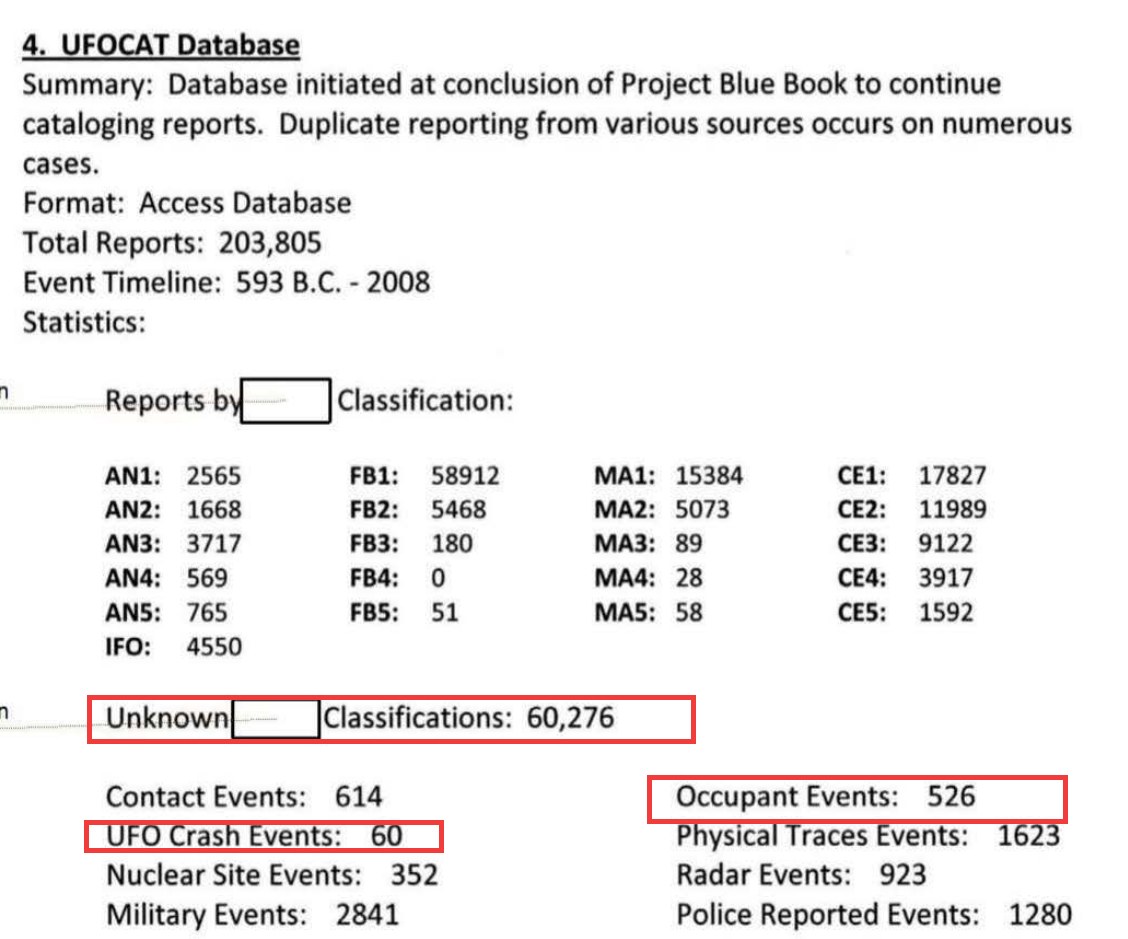
What "occupant" means. The report never defines "Occupant Events" or "UFO Crash Events." The closest it comes is its classification key, which defines CE3 as close encounters where "occupants" or "entities" were present. The UFOCAT listing shows 9,122 reports in CE3, a different and much larger count than 526. The report does not say how the two relate.
The caveats. Twice in the same pages, BAASS tells readers not to over-read the numbers. It says some warehouse reports are duplicates and some "have received classical explanations as natural phenomena." And it says it does "not believe that the breakdown of reports in the data warehouse accurately reflects the percentage of actual sightings," because witnesses are more likely to report a close encounter than a distant unexplained light.
What the document does not say
The report never defines "Occupant Events" or "UFO Crash Events" beyond the tag names. It does not say that 526 occupants were seen, that 60 craft crashed, or that any tagged report was verified. It gives no breakdown of either tag by era, place or source, and does not say who compiled UFOCAT or how its reports were selected. It does not explain what the "Unknown ... Classifications" heading means. The tally counts reports that were filed and cataloged, duplicates and explained cases included.
Why it matters
The numbers are quotable, which is why they need the context the report itself supplies. Read as "526 occupant sightings and 60 crashes," they imply a body of verified cases that no page of this report supports. Read as the report presents them, they are still interesting: a working index of what people reported across some 2,600 years, organized by a contractor trying to turn a scattered record into a searchable warehouse. The honest use of the tally is as a finding aid. It tells a researcher where to dig, not what any one report proves.
Source notes
Document box
- File
- DOW-UAP-D169
- Title
- BAASS Monthly Report, March 2009
- Author
- Bigelow Aerospace Advanced Space Studies (BAASS)
- Date
- April 10, 2009, covering March 1 to 31, 2009
- Length
- 42 pages
- Release
- PURSUE Release 07, Oct 23, 2026
- Primary source
- DOW-UAP-D169 (PDF)
Related files
Headlines and briefs on UAP Wire are editorial summaries of the published records. The primary source controls.