The Sealed Roswell Affidavit in the Pentagon Contractor's Own Management Plan
The document: A sealed 2002 affidavit from Roswell's 1947 press officer sits at the back of a December 2008 plan written by BAASS, the Defense Intelligence Agency (DIA) contractor hired to analyze advanced aerospace threats. The same plan asks DIA to lobby for access to medical samples "under the premise that biological material of potentially non-human origin has been recovered." Why the affidavit is attached, the plan never says. Released Oct 23, 2026, in PURSUE Release 07.
Primary source: DOW-UAP-D168 (PDF)
Key facts
- BAASS's December 2, 2008 Project Management Plan was written under contract HHM402-08-C-0072, which another Release 07 file identifies as a DIA contract.
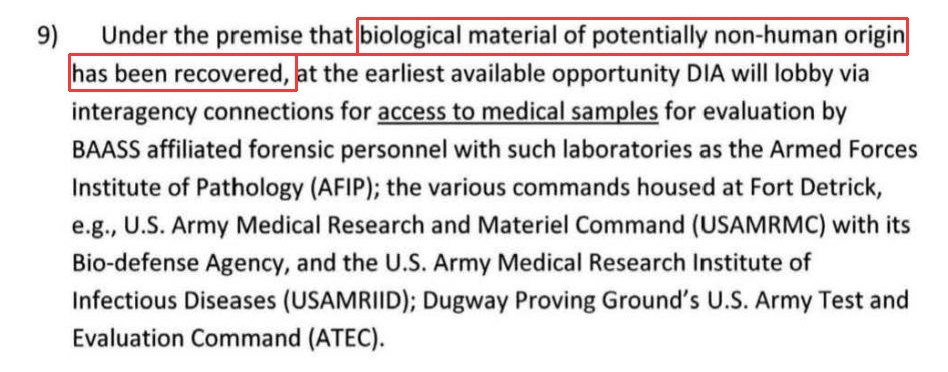
- Recommendation 9 asks DIA to lobby for medical samples "under the premise that biological material of potentially non-human origin has been recovered."
- Recommendation 7 says BAASS has "a list of about ten individuals" tied to retrieval programs, and wants DIA to contact them.
- Appendix 2 is a 2002 "sealed affidavit" from the "Roswell Army Air Force Base Public Information Officer, 1947." His name is redacted.
- The plan never mentions the affidavit outside that appendix heading, and never says why it is attached.
The affidavit, in its own words
The affiant says he was Roswell's base Public Information Officer in July 1947. He describes a staff meeting on July 8 where wreckage was passed around the table: "Pieces which resembled metal foil, paper thin yet extremely strong."
He says a plan, which he believed came from the Pentagon, was discussed to acknowledge one crash site so attention would be diverted from "the more important site north of town." A redacted colleague, he says, phoned his office and dictated the press release saying the base had "a flying disc." His job was to deliver it to local radio stations and newspapers.
Then the hangar. Taken to a heavily guarded building, he says he saw an object "approx. 12 to 15 feet in length" and "more of an egg shape," and, from a distance, "a couple of bodies under a canvas tarpaulin" whose heads "did appear larger than normal." He says he was told of a temporary morgue.
He ends: "I am convinced that what I personally observed was some type of craft and its crew from outer space."
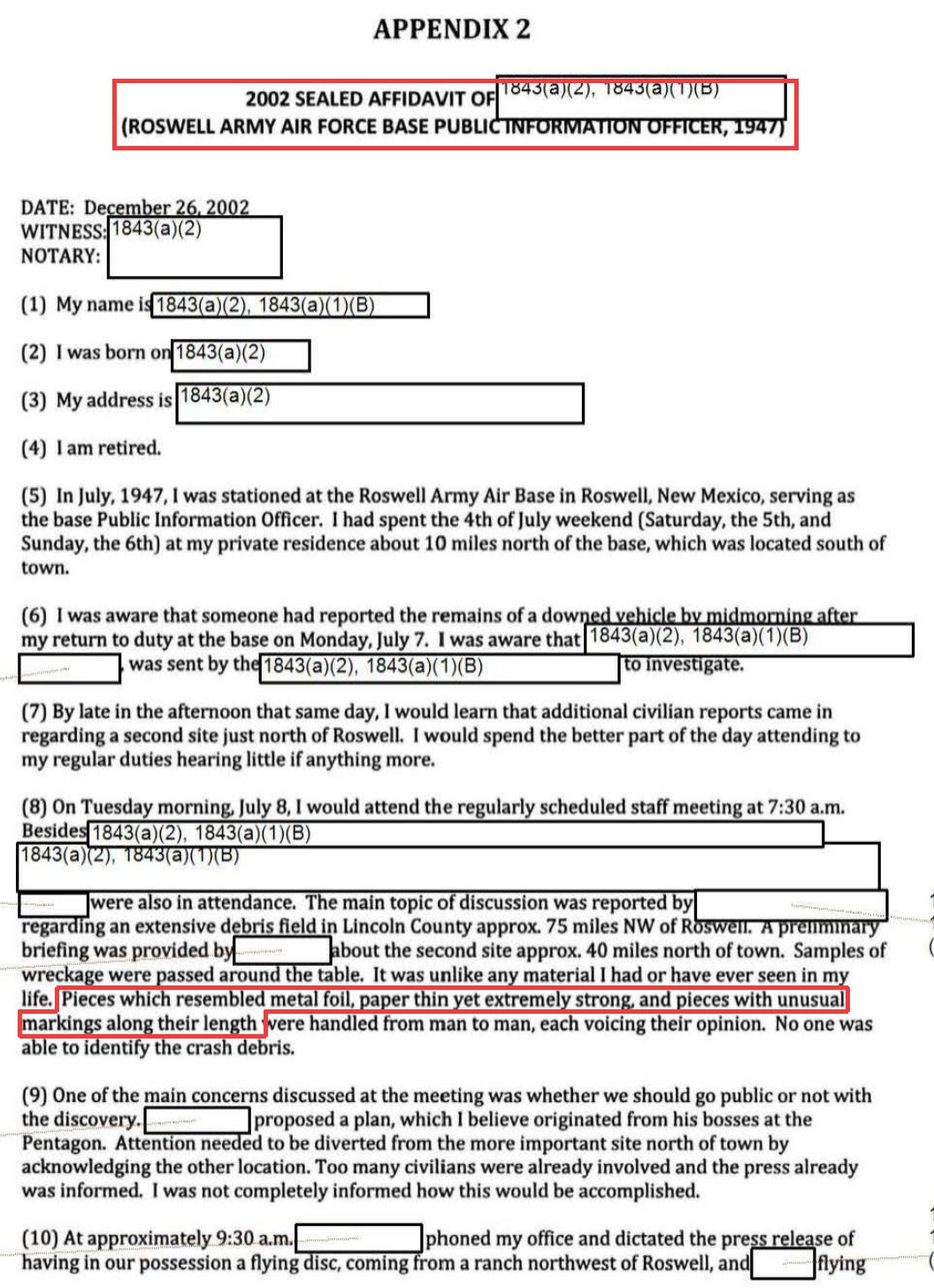
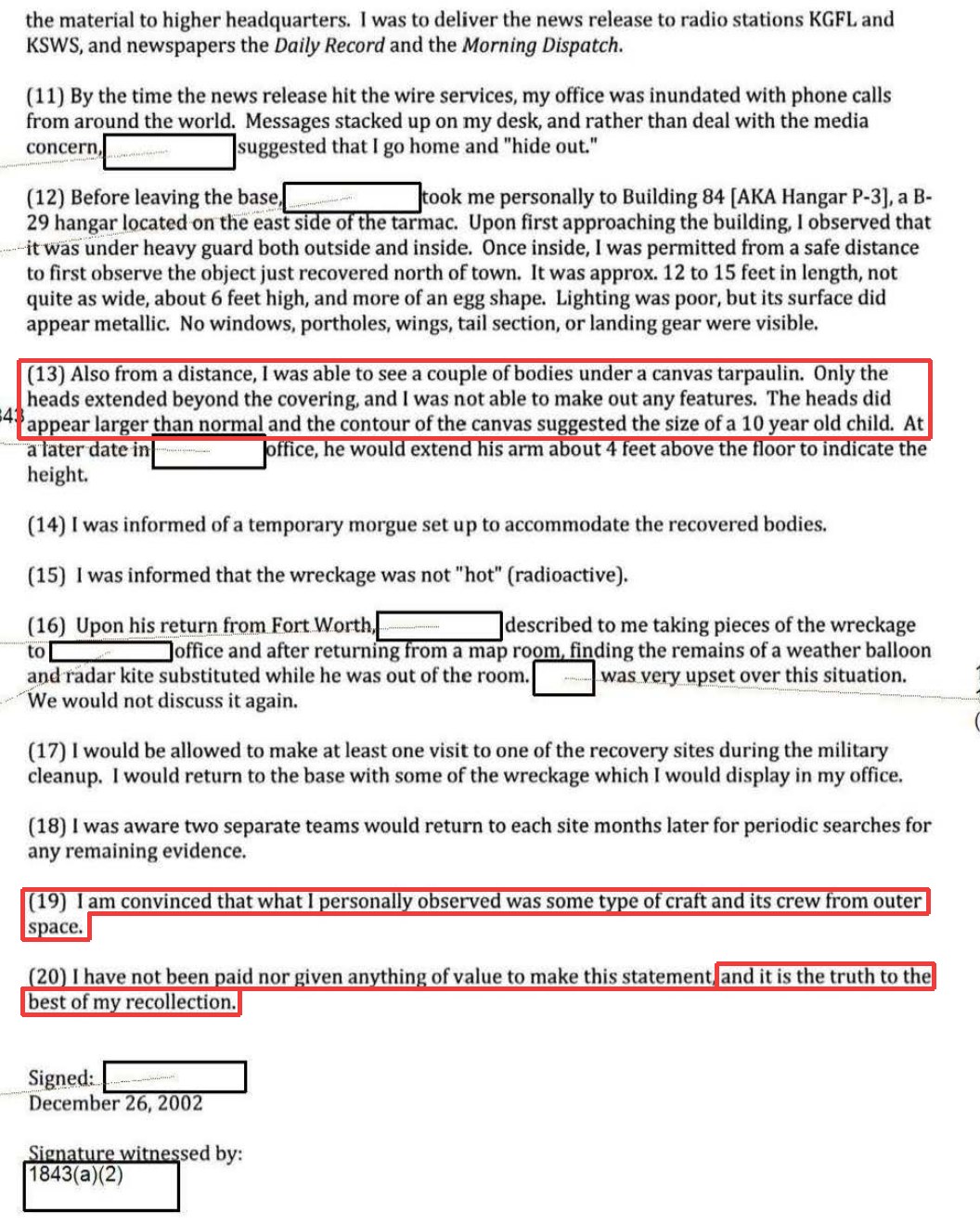
Context, not from this file: the affiant is identified in the public record as Walter Haut, the officer who issued the original 1947 flying disc release. His affidavit was meant to stay sealed until after his death and became public in 2007. Its provenance is disputed: published accounts say the 2002 text was composed by the researcher who later published it and prepared for Haut's signature, and that an earlier 1993 Haut affidavit made no mention of bodies or multiple crash sites. Nothing in Release 07 is new information about 1947; the affidavit has been in print for years.
What the document does not say
The plan never says the affidavit supports any recommendation. It is one man's statement, made 55 years after the events, and every claim in it is his. The plan does not say DIA agreed with BAASS's premise, granted the sample access, or contacted the ten individuals. No BAASS document in Release 07 states that exotic material or tissue was obtained or examined, and the release of this plan is not a DIA finding about Roswell.
Why it matters
On its own, the affidavit is a familiar piece of Roswell literature, with the provenance questions above. In this file it raises a different question: why is it here? The plan never says. What it does show is the company the affidavit keeps.
The same plan asks DIA to lobby for medical samples "under the premise" that biological material of "potentially non-human origin has been recovered," and says BAASS holds a list of about ten people tied to retrieval programs.
Six months later, a BAASS monthly report planned an underground vault for "exotic material or tissue that the organization could obtain." The recovered-material theme was not layered onto this release later; it recurs in BAASS's own paperwork to its customer. That is what the affidavit's presence documents. It is not a new finding, new information about 1947, or DIA endorsing the claims.
Source notes
Document box
- File
- DOW-UAP-D168
- Title
- BAASS Project Management Plan (Overview Paper)
- Author
- Bigelow Aerospace Advanced Space Studies (BAASS), under contract HHM402-08-C-0072 (identified as a DIA contract in D175)
- Date
- December 2, 2008
- Length
- 49 pages; the affidavit is Appendix 2, pp.45-46
- Release
- PURSUE Release 07, Oct 23, 2026
- Primary source
- DOW-UAP-D168 (PDF, at Appendix 2)
Related files
Headlines and briefs on UAP Wire are editorial summaries of the published records. The primary source controls.