A Magnet Craft, Cold Fusion and Implants: MUFON's Shopping List for the Pentagon Contractor
The document: In November 2008, MUFON's Advanced Technology Establishment prepared five research papers for BAASS, the Defense Intelligence Agency contractor, each marked BAASS Confidential: a superconducting magnet craft, a cold fusion reactor to buy, and a study of tiny implants MUFON says it holds x-rays of. Every claim is MUFON's, and the file never says BAASS bought, funded or acted on any of it. Released Oct 23, 2026, in PURSUE Release 07.
Primary source: DOW-UAP-D166 (PDF)
Key facts
- Five MUFON papers, prepared for BAASS in November 2008 and each marked BAASS Confidential: Lift, Power Generation, Control, Human Interface and Propulsion.
- The Lift paper proposes a small superconducting model to test a "Toroidal Magnet Craft" that would use the Earth's magnetic field for lift.
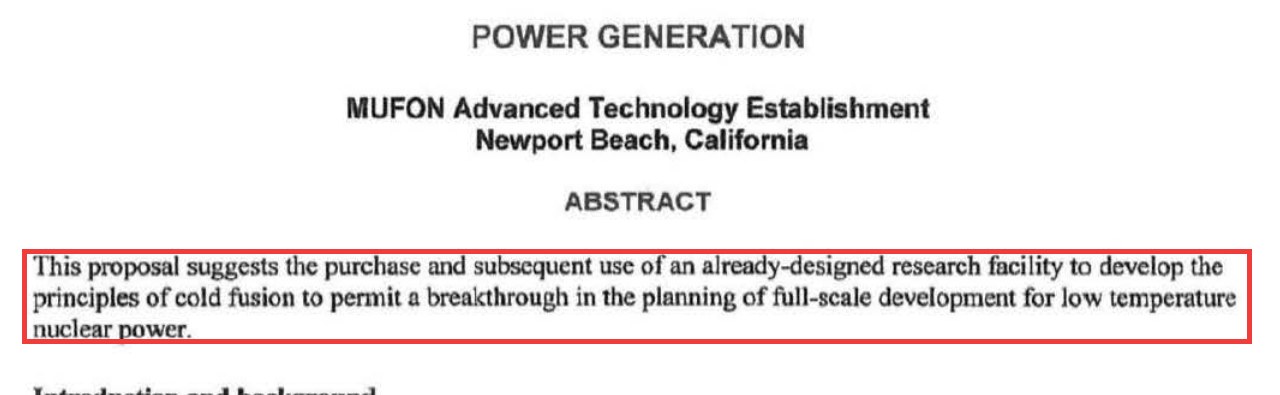
- The Power Generation paper proposes buying an already designed cold fusion research reactor, offered at about $10,000 for materials.
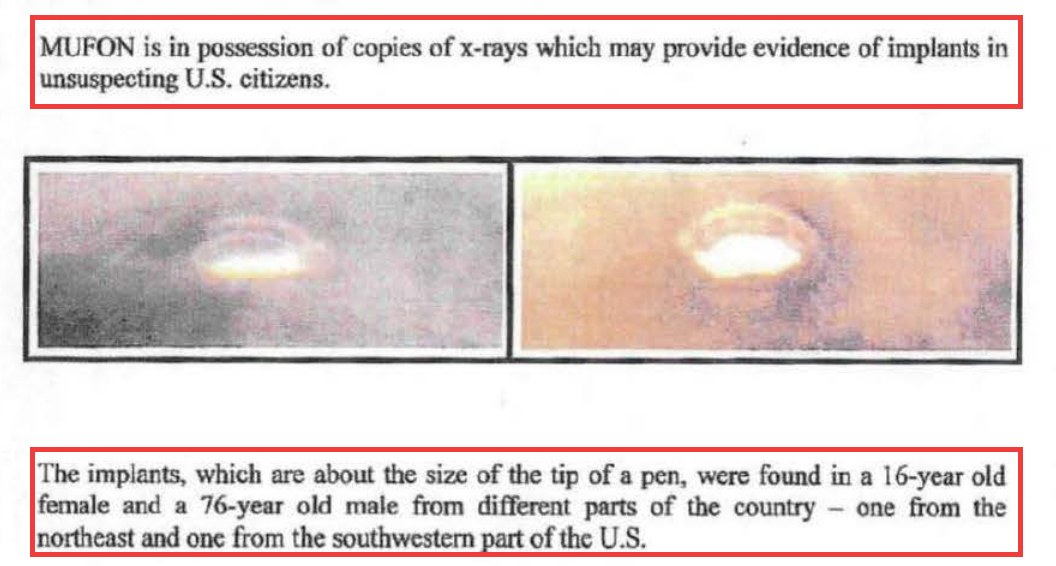
- The Human Interface paper proposes studying implants in people. MUFON says it holds copies of x-rays that "may provide evidence" of pen-tip-sized implants in a 16-year-old and a 76-year-old.
- The file never says BAASS funded, accepted or answered any of it.
What the document says
The magnet craft. The Lift paper concludes that using the Earth's magnetic field with superconductors "has merit." Its reasoning: reported hovering craft make little noise, which "suggests they do not move air around to stay afloat." The Toroidal Magnet Craft section puts numbers on the idea: a 100-foot craft might need 10^11 amps. The plan is modest next to the ambition: a three-person team, a small tethered model, a preliminary conclusion in six months. Its milestones run from "Week 0: Team under contract" to "Week 17: Results surprise everyone, require redesign" and "Week 25: Proof of principle established."
The reactor. The Power Generation paper is the most concrete ask. MUFON proposes buying an already designed research facility to develop the principles of cold fusion: the EDTEK scanning reactor, whose builder is "reportedly willing to sell at cost," about $10,000 for materials only. The test schedule runs to repeatable data at week 26, and the paper calls it "a great chance to pick up a well-planned unit designed to prove the reality of cold fusion." The unit is meant to prove cold fusion is real, not to apply a proven result.
The implants. The Human Interface paper, from MUFON's Delafield group, is the strangest and the most careful about its own limits. Its abstract says studying implants found in people could lead to technologies with "unlimited possibilities for payoff" in mind control for vehicles, defense systems and medicine. It states plainly that numerous implants have been discovered and removed, and that how they were placed and what they monitor "is unknown." It hypothesizes they are bi-directional communication devices, and that reverse engineering them could yield a "direct mind-to-vehicle interface."
MUFON says it holds "copies of x-rays which may provide evidence of implants in unsuspecting U.S. citizens." The objects, it says, are about the size of the tip of a pen and were found in a 16-year-old female and a 76-year-old male from different parts of the country.
The study MUFON sketches would need volunteers with implants detected in current scans, and a team of a physician or dental surgeon, a radio-frequency engineer, a biochemist, a biophysicist, a project administrator and two mental health professionals, over 18 to 24 months. The data would go to "our sponsor," never named.
Two more papers round out the bundle: a Control paper on steering a superconducting toroid craft, and a Propulsion paper on theories for interstellar travel. MUFON was offering a research program, not one idea.
What the document does not say
It does not say BAASS commissioned, funded, accepted or answered any of these proposals. The only BAASS connection the file states is the cover title and the BAASS Confidential footer on the papers. One detail cuts against a simple pitch reading: the implant protocol is described as "developed and proposed to MUFON," not to BAASS. And the file does not say the implants are non-human in origin, that any device worked, or that the reactor produced anything.
Why it matters
Much of Release 07 is the contractor's own paperwork. This file is the other side of that relationship: what an outside UFO organization prepared for the contractor, in its own words, with budgets, teams and timelines attached. MUFON offered a magnet craft, a reactor and an implant study, and the file ends there, with no answer from BAASS in it. Readers who want proof of any of it will not find it here.
Source notes
Document box
- File
- DOW-UAP-D166
- Title
- MUFON Reports Prepared for BAASS
- Author
- MUFON Advanced Technology Establishment (groups in Newport Beach, Fort Collins, Delafield and Austin)
- Date
- November 2008
- Length
- 26 pages, five papers
- Release
- PURSUE Release 07, Oct 23, 2026
- Primary source
- DOW-UAP-D166 (PDF)
Related files
Headlines and briefs on UAP Wire are editorial summaries of the published records. The primary source controls.