Ten Minutes Over Guam: The F-86D Pilot Who Could Not Catch a Blinking Light
The document: An Air Force intelligence report dated February 1957 carries a pilot's account of a night chase over Guam on December 31, 1956, and the investigation that followed. Released Oct 23, 2026, in PURSUE Release 07.
Primary source: DOW-UAP-D156 (PDF)
Key facts
- At 1610Z on December 31, 1956, an F-86D pilot in the Guam radio range holding pattern sighted an unidentified blinking white light.
- The report describes it as round and dime-sized, steady for about four seconds, then blinking quickly, then steady again.
- Over about ten minutes it turned with the interceptor, ran south about ten miles, climbed to about 30,000 feet and circled the fighter twice, once while the pilot pursued in afterburner and could not close.
- A lighted weather balloon launched earlier that night was the only explanation the file investigated.
- The conclusion is conditional: unless that balloon malfunctioned and stayed low, the object "can not be readily explained."
What the document says
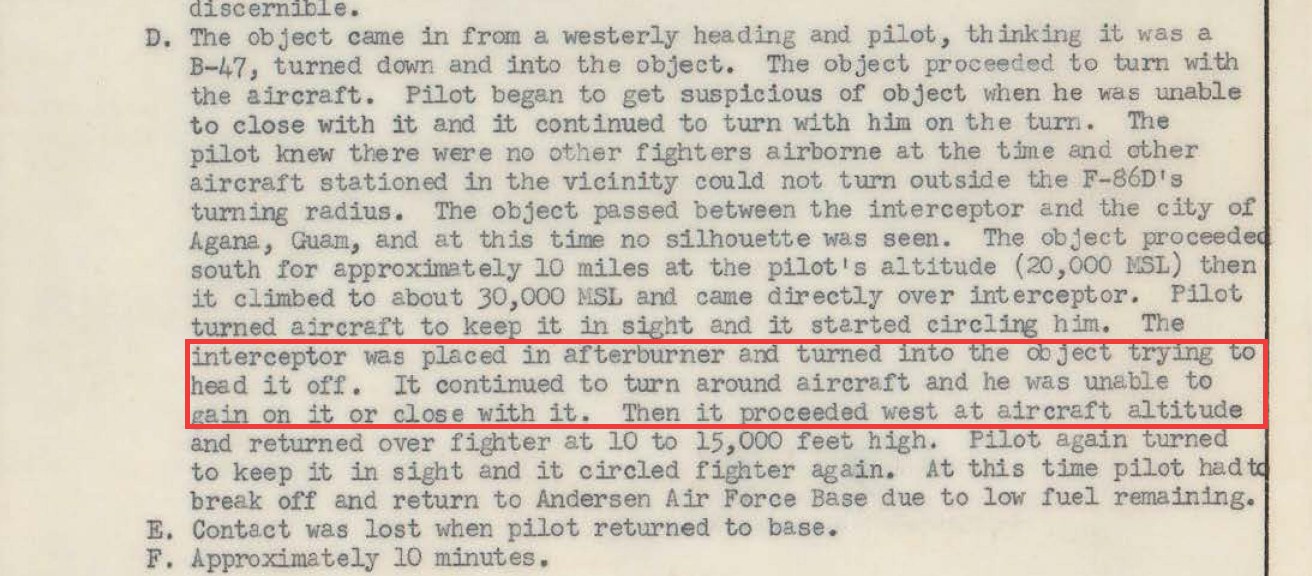
The chase. The pilot was in a holding pattern over the Guam radio range when, the report says, the object passed under his aircraft from the west. He thought it was a B-47 and turned down and into it. He grew suspicious when he could not close with it and it kept turning with him. He knew no other fighters were airborne, and that other aircraft in the area could not turn outside the F-86D's turning radius.
The object passed between the interceptor and the city of Agana, where, the report says, "no silhouette was seen." It ran south about ten miles at the pilot's altitude, given as 20,000 feet, climbed to about 30,000 feet and came directly over him. He turned to keep it in sight, and it started circling him. In afterburner he turned into it to head it off, but "was unable to gain on it or close with it."
Then it went west at aircraft altitude, returned over the fighter at 10,000 to 15,000 feet and circled again. Low on fuel, the pilot broke off for Andersen Air Force Base, and contact was lost on the way back. Total time: approximately ten minutes. He tried to learn the object's type and shape, the report says, and "succeeded only in keeping it in sight."
The form describes the observer as "considered very reliable, no other supporting." Conditions were clear: broken clouds near 3,000 feet, clear above, visibility 15 miles plus. No other traffic was known, and a check of all fields and control stations verified it.
The balloon check. Because the sighting resembled reports of weather balloons, the 7th Air Force checked for lighted balloons. One had been launched at 1432Z by the U.S. Weather Bureau at the U.S. Navy Communications Station. It was last tracked five miles west of the station at 20,000 feet at 1500Z, then lost from view an hour and ten minutes before the sighting. Asked again, the pilot said he did not believe the object was a weather balloon because it "maneuvered with the F-86D and accelerated past his aircraft."
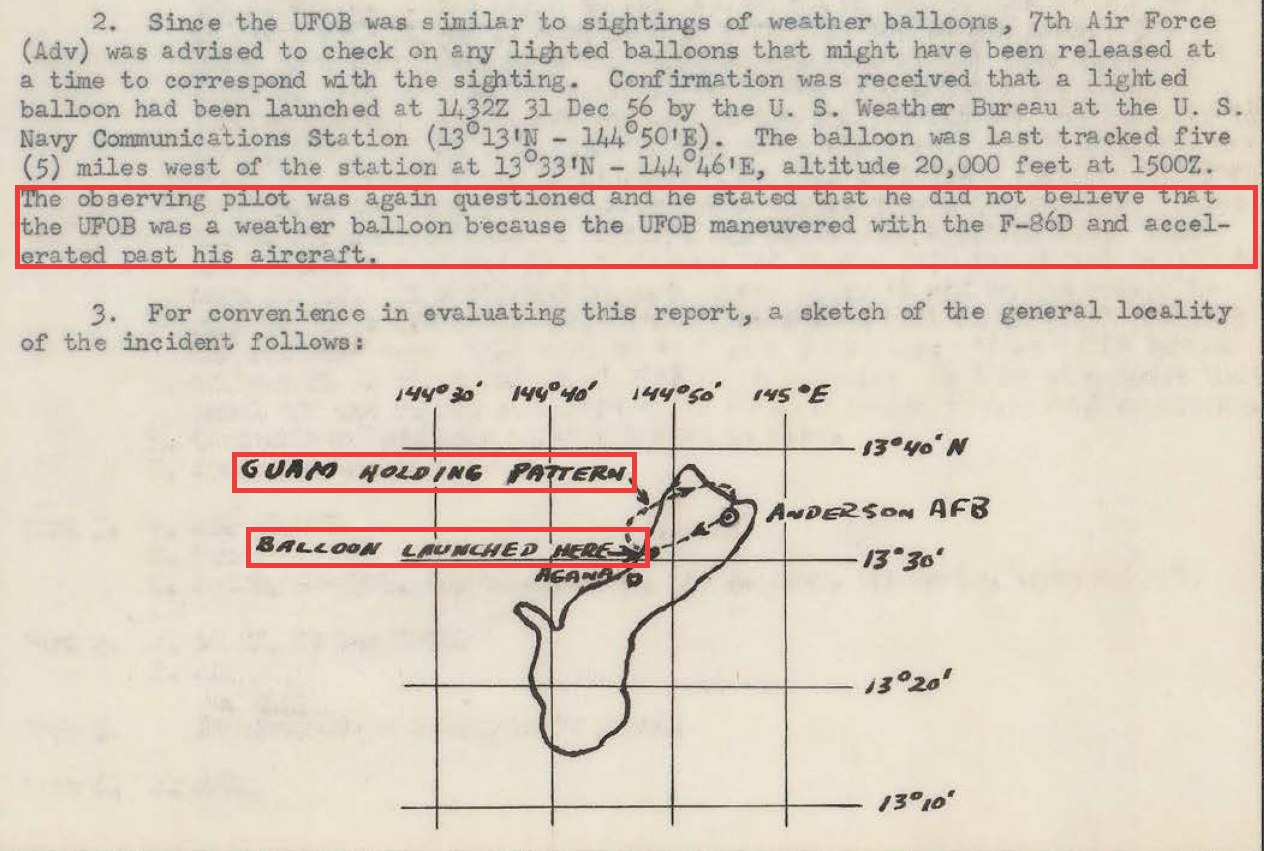
The conditional. The preparing officer's comments do the arithmetic. The balloon climbed more slowly than standard, but if it had ascended normally it would have been "much higher than the altitude of the reported sighting." If it "had malfunctioned and leveled off or descended," the officer wrote, it "could possibly explain the reported UFOB."
What the document does not say
It does not identify the object. It does not say the balloon was the object, only that a malfunctioning balloon could possibly explain it. It does not describe any shape beyond a round light, and it records no silhouette at the closest pass. It does not resolve the pilot's objection: nothing in the file explains how a balloon maneuvered with a jet and accelerated past it. And it does not claim the case was solved. The summary's final sentence is a conditional, not a verdict.
Why it matters
Many of the historical files in this release are fragments: a page, a memo, a witness line. This one is a complete case, chase narrative and investigation together. A reader can follow the pilot's ten minutes, then the balloon check, then see exactly where the official explanation stops: at a conditional the pilot himself disputed, preserved in the file. The early Air Force system did investigate, did find a plausible candidate, and still left the case open on its own terms.
Source notes
Document box
- File
- DOW-UAP-D156
- Title
- Air Intelligence Information Report, Unidentified Flying Object Report
- Report number
- IR-7-57
- From
- DI FEAF ATILO, as printed on the report
- Event
- 1610Z, December 31, 1956, Guam radio range holding pattern
- Report date
- February 8, 1957
- Length
- 4 report pages, plus a fifth hosted page that is an upside-down copy of page 4
- Release
- PURSUE Release 07, Oct 23, 2026
- Primary source
- DOW-UAP-D156 (PDF)
Related files
Headlines and briefs on UAP Wire are editorial summaries of the published records. The primary source controls.