A 1963 Memo Reports a NASA Official's View That the Military Wanted NASA as "Cover"
The document: A one-page memo dated May 29, 1963, from R. W. Hale to Dr. Welsh, reports an hour-long meeting with Frutkin, a NASA official, about who should publicly own the return of recovered fragments. Released Oct 23, 2026, in PURSUE Release 07.
Primary source: EOP-UAP-D002 (PDF)
Key facts
- R. W. Hale wrote to Dr. Welsh on May 29, 1963, after meeting Frutkin and his assistant Marvin Robinson the day before.
- Frutkin was "very negative on the project," Hale says. A companion Release 07 file lists Frutkin as NASA's representative.
- In Hale's account, Frutkin felt no public announcement was needed, and that a White House statement would "scare people needlessly."
- Frutkin also felt the Defense Department and Air Force "want to use NASA for a 'cover'" but would let NASA do nothing "but return some pieces."
- The memo never says what the fragments were, and never mentions UAP, UFOs or anything non-human.
What the document says
The memo. Hale, writing to Dr. Welsh, says he met Frutkin and his assistant for more than an hour on May 28, and had to review last year's meetings because Frutkin "was away at the time and now is very negative on the project." Then the key line: "Frutkin seems to feel that," followed by seven numbered points.
The first points are about publicity. Frutkin felt no public announcement was needed, and that an Executive Order or a White House statement "would scare people needlessly." The problem, he said, was overseas, and State would like to point to NASA as the "U. S. responsible agency (without a scary public announcement)."
The "cover" line. Point 4 is the one that stands out. Frutkin felt the Defense Department and the Air Force "want to use NASA for a 'cover' but have no intention of letting NASA do anything but return some pieces." The quotation marks around "cover" are in the memo itself.
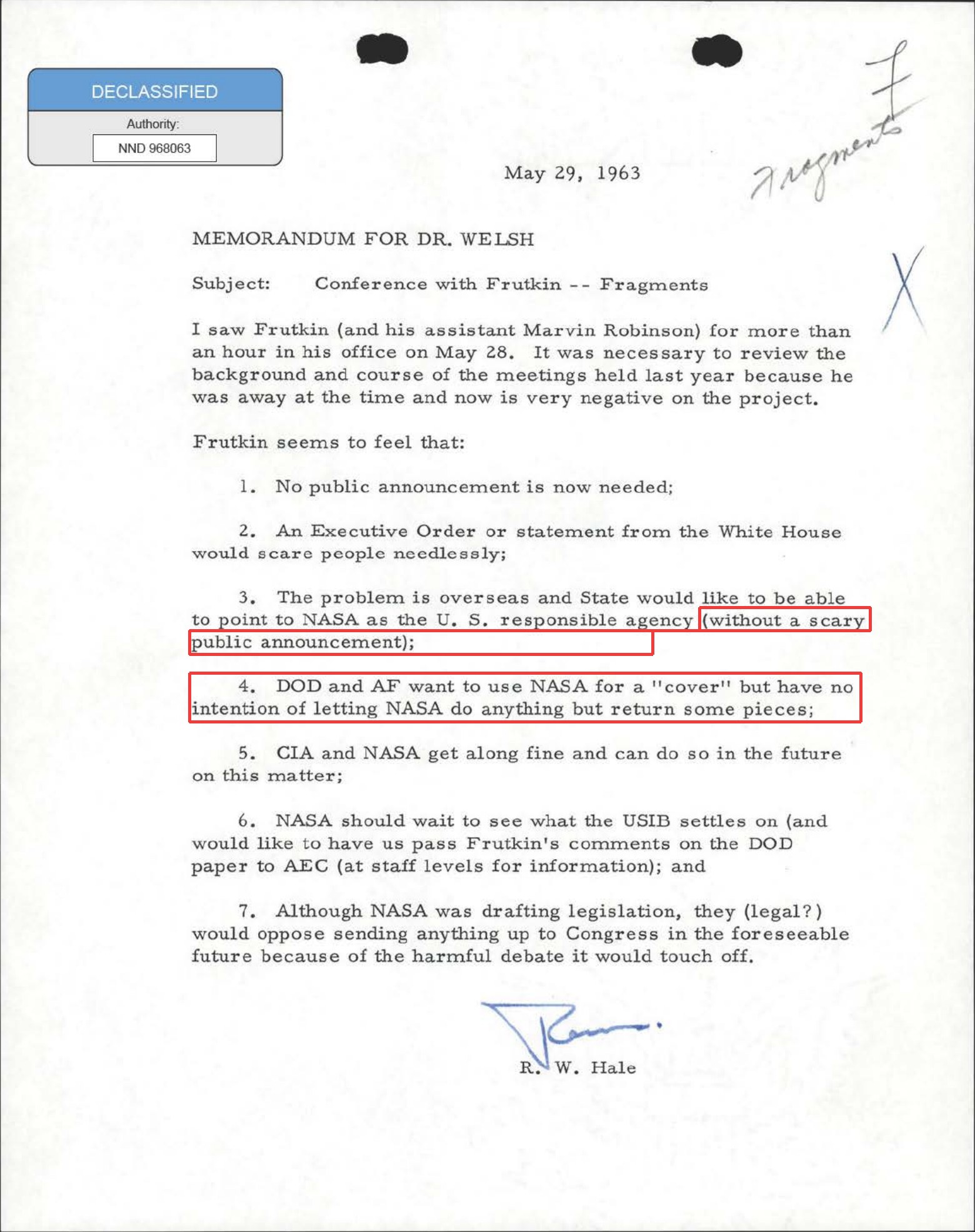
The rest is process. The CIA and NASA "get along fine." NASA should wait to see what the USIB settles on. And although NASA was drafting legislation, "they (legal?)" would oppose sending anything to Congress in the foreseeable future because of "the harmful debate it would touch off."
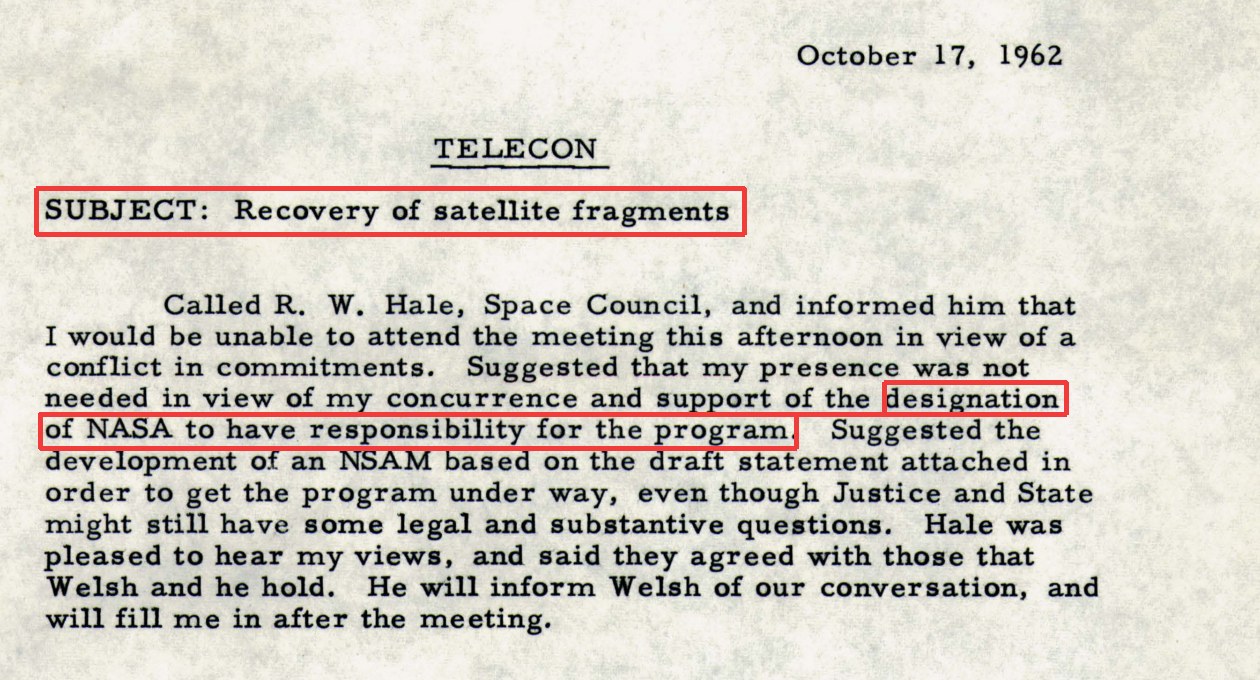
Context, not from this memo: a separate Release 07 file, USG-UAP-D002, collects 1962 to 1964 correspondence on the same subject. Its folder is titled "Space Vehicle Fragments - Responsibilities and Procedures," an October 1962 telecon in it is headed "Recovery of satellite fragments," and it identifies R. W. Hale as Space Council and Arnold Frutkin as NASA. The release does not say this memo belongs to that file, but the names and the subject match. Read together, the fragments most plausibly were fallen space hardware, not craft.
What the document does not say
It does not say what the fragments were, where they fell, or which country they came from. It does not say the Defense Department or the Air Force agreed with Frutkin's view: every point is introduced as what Frutkin "seems to feel," and the memo has no Defense Department reply. It does not say whether any announcement was made, whether NASA was named the responsible agency, or what happened to the fragments. And it does not mention unidentified flying objects, unidentified aerial phenomena, saucers, or recovered craft of any kind.
Why it matters
This memo matters for two reasons that pull in opposite directions. It is a genuine primary document about cover and messaging: in 1963 a NASA official, as reported by another official, seems to have believed the military wanted a civilian agency as the public face for returning recovered material while keeping control of everything else. The language is blunt for a government file: "cover," "scary public announcement," "scare people needlessly."
But it is not a UAP document, and treating it as one would be a mistake. Nothing in it connects the fragments to anything unidentified or non-human, and the companion file points to satellite fragments. Its presence in a UAP release shows the release sweeps in whatever a folder held, including ordinary interagency paperwork about space debris. The honest headline is not that the government hid a craft behind NASA. It is that officials argued, on paper, over who should stand in front of the public when fragments came down.
Source notes
Document box
- File
- EOP-UAP-D002
- Title
- Memo on Interagency Coordination for the Recovery of Foreign Materiel, May 1963 (the release's title; the memo's own subject line is "Conference with Frutkin -- Fragments")
- Author
- R. W. Hale (signature on the memo; listed as Space Council in USG-D002 p.62)
- Recipient
- Dr. Welsh
- Date
- May 29, 1963 (meeting described: May 28, 1963)
- Length
- 1 page
- Release
- PURSUE Release 07, Oct 23, 2026
- Primary source
- EOP-UAP-D002 (PDF)
Related files
Headlines and briefs on UAP Wire are editorial summaries of the published records. The primary source controls.