The "Skinwalker" Hair Came Back Dog: Inside the Utah Ranch File
The document: In spring 2010 a four-person team from BAASS, the contractor the Defense Intelligence Agency hired to build an organization to analyze "advanced aerospace technology," made two trips to a ranch near Fort Duchesne, Utah, to look for the creatures and lights local witnesses described. The report, released Oct 23, 2026 in PURSUE Release 07, is two documents in one cover: a field log of strange accounts, and a lab notebook of tests that are mostly unfinished, with one result that is plainly ordinary.
Primary source: DOW-UAP-D174 (PDF)
Key facts
- The team was four BAASS staff, two investigators and two scientists, on trips March 22-26 and April 19-23, 2010, to find "evidence of the reported unidentified creatures and lights" [D174 p.5]. The ranch's name is redacted; the report calls it the Utah Ranch.
- Stated aims included "definitive photographic, digital, sound and chemical evidence" and "games, puzzles, and other strategies in order to establish communication with the source/origin of reported anomalies" [D174 p.8].
- By May 7, 2010 the team had interviewed more than 25 people. Eleven independent witnesses described a large dog-like creature that walks on two legs, six to seven feet tall upright [D174 pp.8-9].
- One witness said a red ball of light came within about four inches of his face, with ringing in his ears, warmth, and numbness on part of his face for a few minutes. The report notes he was fixing his car radio and could not give the interview his full attention [D174 pp.15-16].
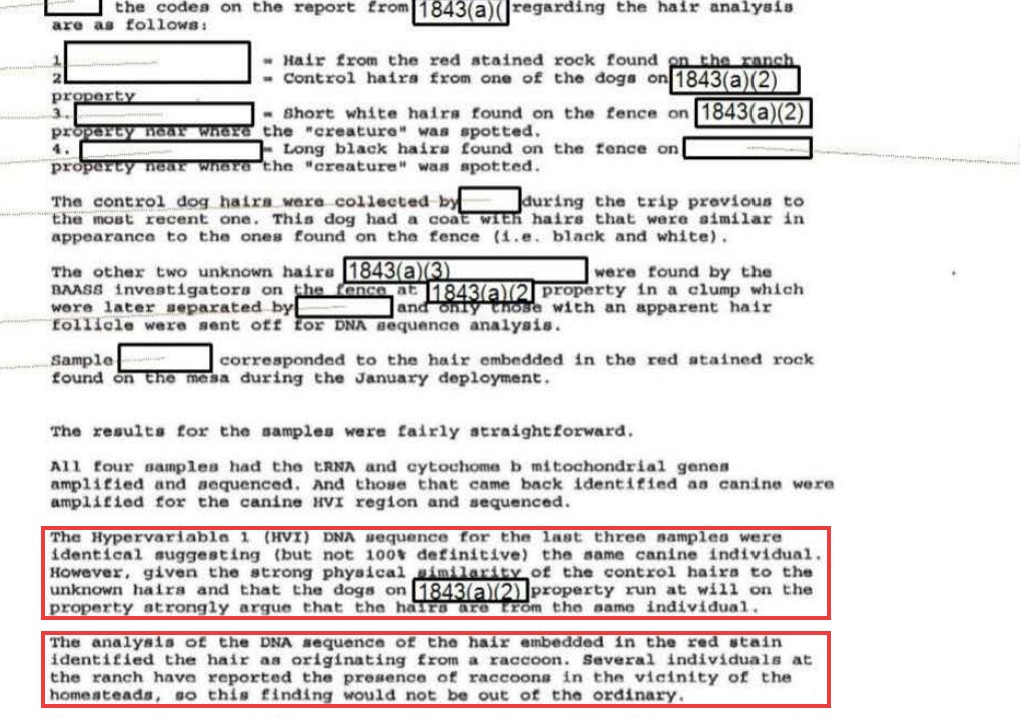
- The only laboratory result in the report is a hair test. Three of four samples, including control hair from one of the ranch family's dogs, shared the same canine DNA sequence. The fourth, hair embedded in a red-stained rock, was raccoon [D174 pp.37-38].
- A radio sweep found two strong signals between 1210 and 1238.5 MHz that were "not present the day before." The report does not identify them and calls for more measurement [D174 pp.9-10].
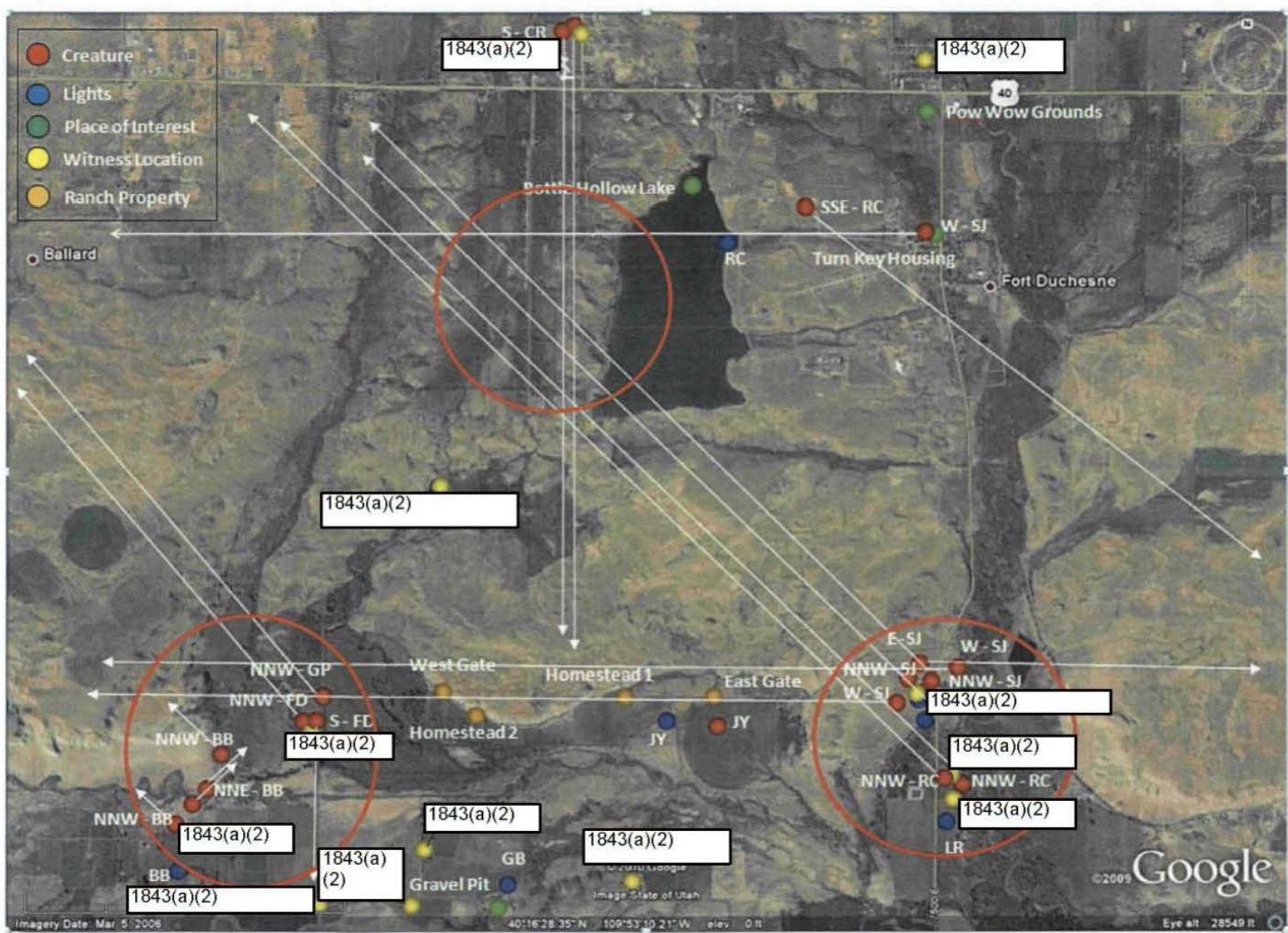
- The creature-sighting map extrapolates straight lines from witness directions. The authors say the crossing points "could be construed as arbitrary," yet call the clustering "noteworthy" [D174 p.6].
What the document says
The setup. BAASS is the contractor the Defense Intelligence Agency's Defense Warning Office hired, between 2008 and 2010, to create, staff and equip an organization to analyze the national security threat of "advanced aerospace technology" [D175]. D174 is its field report from the ground: two trips to a ranch near Fort Duchesne, Utah, by two investigators and two scientists, who interviewed residents, installed game cameras, collected hair and ran experiments [D174 p.5]. The ranch's name is blacked out. The word that runs through the interviews is "Skinwalker," and a separate Release 07 BAASS field log, D173, discusses security at "the Skinwalker Ranch."
The map. BAASS plotted each witness-reported creature sighting and its last direction of travel on a Google Earth image, then extended straight lines through them. Three crossing points appear, all near the ranch: one just west of it and two near Bottle Hollow reservoir [D174 p.6]. The authors undercut their own picture in the next breath: the crossings "could be construed as arbitrary," because the creatures "may have changed their direction of travel once out of sight." Still, they call the clustering "noteworthy" and suggest the three circled spots as places for sustained night watching.
The accounts. The file is full of them. Eleven independent witnesses described a large dog-like creature that walks and runs on two legs. Four described small, hairy figures about three feet tall. Others reported "worm" like creatures, a pterodactyl-like bird with a wingspan of roughly twelve feet, and "little people" [D174 pp.9, 12]. The report's own word for the stranger claims is "allegations" [D174 p.9]. Its details range from a creature seen leaping between rooftops to a witness's "portal," a transparent, rippling wall seen twenty years earlier, to a hum a resident says shakes windows [D174 pp.11-13].
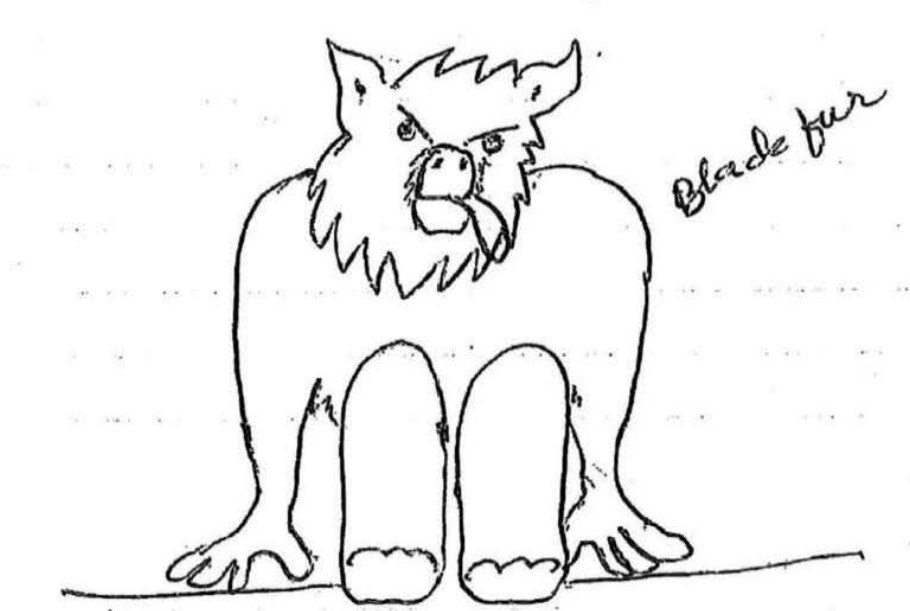
One witness drew the creature for investigators on April 21, 2010: black fur, a snout like a pig's, "the size of a 'big man.'" The report is careful to note where a witness's own explanation is a guess: he said horses once ran erratically in a field, assumed a creature was scaring them, and the report adds that the assumption, "by his own admission, is clearly speculation" [D174 p.29].
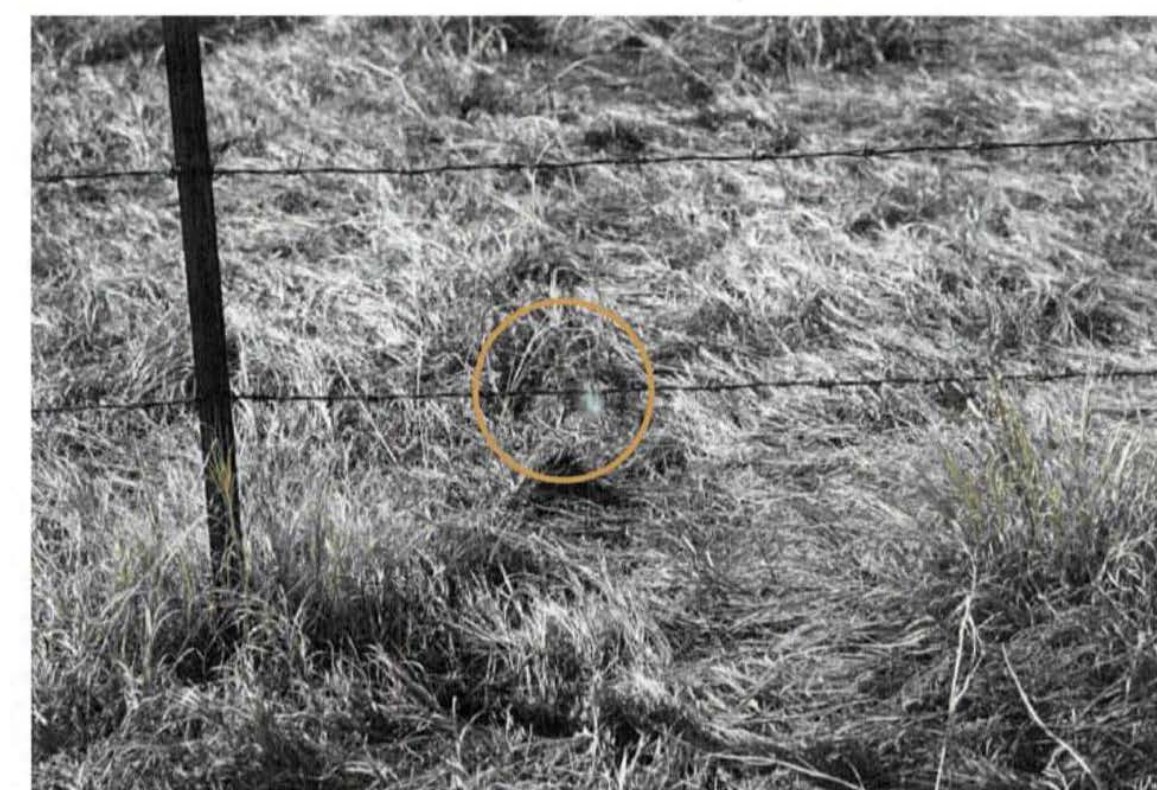
The hair. In March a witness told investigators that a "Skinwalker" had run through his barbed-wire fence, chased by his dogs. An investigator searched the fence line and found fur caught on a barb that matched the color the witness described [D174 pp.5, 17]. Hair from that fence, and from the ranch, went to a lab.
The lab ran four samples (listed in BAASS's own email): hair from a red-stained rock found on the mesa, control hair from one of the ranch family's dogs, and two sets of hairs from the fence, short white and long black [D174 p.38]. Three of the four, the control hair and both fence samples, carried the identical canine sequence, one the lab says would be expected in 9.8% to 13.8% of random dogs [D174 p.37]. BAASS's own reading: the match suggests, though not definitively, the same dog, and the hairs' resemblance to the control hair and the fact that the dogs "run at will" on the property "strongly argue" it [D174 p.38]. The fourth sample, the rock hair, was raccoon, which BAASS notes "would not be out of the ordinary," since residents report raccoons near the homesteads [D174 p.38].
The signal. Electromagnetic sweeps on the mesa recorded two large signals, around 1210 to 1216 MHz and 1232.5 to 1238.5 MHz, that "were not present the day before." The report calls the first reading "strong, yet to be explained," notes the bands carry satellite and military allocations, and says further work on satellite transmitting frequencies and times "will be required to identify the origin" [D174 pp.9-10]. That is an open question, not an answer.
The rest of the lab. BAASS set out biosensor plants, a tobacco line with a natural sulfur-gene mutation and spiderwort, as living detectors for radiation or DNA-damaging agents, and began seed-growth trials against a control run at BAASS. After two weeks the report says "no observations or analysis can be drawn," and the tobacco showed no mutation spots [D174 pp.30-33]. Seven game cameras were installed across the ranch and a neighboring property [D174 p.5], four were described as in operation later [D174 p.18], and none of the report's listed figures is a camera image [D174 p.4].
What the document does not say
It does not say what the creatures or lights are, and it presents none of the accounts as established. It does not claim verified anomalous physical evidence: its one laboratory result points to a dog and a raccoon. It does not identify the radio signals. It does not show results from the plant or seed experiments, which had only just begun, and it describes tracks in the snow as unidentified without including the photographs [D174 p.9]. It does not debunk the witnesses either: it records their accounts as accounts.
Why it matters
The Skinwalker story usually reaches readers as retellings. D174 is the contractor's working notebook: interviews, drawings, a map the authors themselves doubt, a signal they could not place, plants and seeds in a trailer, and a hair result that came back dog. That mix is the story. It shows serious effort aimed at an unusual target, and it shows the limits of that effort, in the contractor's own words. It also shows where a Defense Intelligence Agency contractor's time and curiosity went in the spring of 2010, and what it had to show for it by May.
Document box
- File
- DOW-UAP-D174
- Title
- Utah Ranch Investigation Report (the release dates it April 2010; the report's contents run to early May 2010)
- Author
- Bigelow Aerospace Advanced Space Studies (BAASS), Las Vegas, NV; contractor to the Defense Intelligence Agency [D175]
- Event
- Two trips, March 22-26 and April 19-23, 2010, to a ranch near Fort Duchesne, Utah (ranch name and witness identities redacted)
- Release
- PURSUE Release 07, Oct 23, 2026
- Primary source
- DOW-UAP-D174 (PDF)
Related files
Headlines and briefs on UAP Wire are editorial summaries of the published records. The primary source controls.